Water Filter vs Purifier for Hiking: Which One Do You Actually Need
Author:Alina
|
Released:February 15, 2026
Drinking untreated water along the trail may spoil your hiking experience by causing stomach cramps, vomiting, or even worse. Knowing the distinction between water filters and purifiers enables you to select the correct safeguard for your adventure.
The two approaches address various threats. Choosing the wrong one exposes you to certain pathogens that may require hospitalization.
What Water Filters Actually Remove
A hiking water filter is a physical method of straining out the pollutants by forcing the water through the small holes. The pore size of most backpacking filters is 0.1 to 0.2 microns. This traps protozoa such as Giardia and Cryptosporidium, that causes deadly intestinal disease. Bacteria such as E. coli, Salmonella, and Campylobacter are also filtered out.
The Sawyer Squeeze and Katadyn BeFree control the lightweight filter market. They both weigh less than three ounces and provide fast, lightweight water treatment. The CDC substantiates that protozoa and bacteria can be effectively removed in water sources with the help of filters that comply with the NSF Standard 53 or 58 [1].
There is, however, a very important limitation of filters. Viruses are tiny and average between 0.02 and 0.3 microns. They pass through normal filter pores easily. Viral contamination is uncommon in most North American wilderness regions, so regular backcountry expeditions are usually adequate with filters. That said, filters should not be treated as a universal solution for every hiking destination.
A filter also does not remove chemicals, heavy metals, or dissolved pollutants, so it is not a solution for industrial runoff or visibly contaminated water.
What Water Purifiers Handle That Filters Cannot
Besides bacteria and protozoa, water purifiers remove viruses. They do this by chemically treating, using ultraviolet light, or using very fine filtration. Hepatitis A, Norovirus, and Rotavirus are examples of viruses that need to be neutralized by means of purification.
The UV purifiers, such as the Steripen,n make use of UV rays to scramble the DNA of pathogens, making them incapable of reproduction. Chemical methods, ds such as the use of chlorine dioxide tablets and iodine, are based on the principle of oxidizing cell membranes. The MSR Guardian is among the few pump devices that physically separate viruses by means of hollow fiber technology with pore sizes of medical grade.
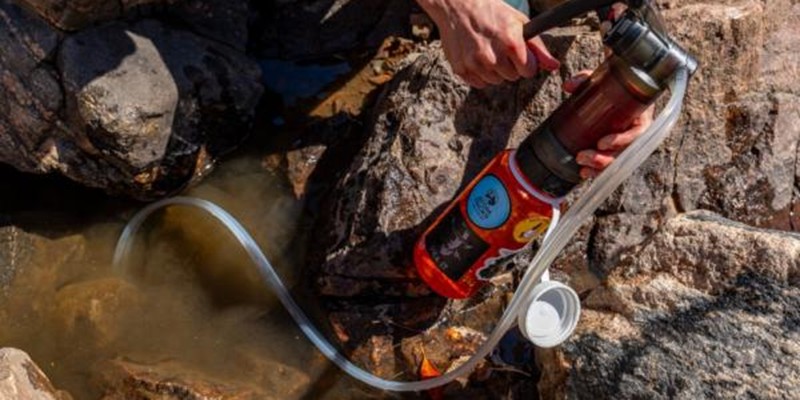
EPA suggests that international travel that involves poor sanitation infrastructure and frequent viral contamination should be purified [2]. There is an increased viral risk in developing countries, high human traffic areas, and water sources where agricultural runoff is high. If the water is muddy, silty, or full of organic debris, pre-filter it through a bandana, coffee filter, or cloth before using a UV purifier or chemical treatment.
When To Use A Filter Vs A Purifier
A good quality filter offers sufficient protection for most hiking in the United States and Canada. Water bodies in the wilderness that are distant from human populations mostly harbour protozoa and bacteria due to animal waste. This category is normally associated with national parks, designated wilderness areas,s and remote alpine lakes.
Use purification when walking in populated regions, downstream of campgrounds, or in unsanitary regions. Viral protection is needed in places such as Nepal, Peru, and Southeast Asia as international trekking destinations.
Another factor to consider is purification during the festival seasons or in the high seasons when there is heavy traffic, which poses a higher risk of contamination. If you are hiking near towns, farms, or campgrounds, a purifier is usually the safer choice. Somee hikers carry both. A light filter is used to collect water fast, and in case of doubtful water sources, chemical tablets are used as a backup purification. This combination is nearly weightless and applies to every scenario. Many experienced hikers use this exact system because it combines speed, convenience, and backup protection.
Comparing Popular Treatment Methods
Squeeze filters such as Sawyer are the most balanced between speed, weight,t and effectiveness in the backcountry. They can do one liter in less than a minute, and they are about two ounces. Disadvantages are freezing weakness and backflushing to sustain the low rate. Filters should never be allowed to freeze while wet, because freezing can damage the membrane and make the filter unreliable, even if it still looks intact.
UV purifiers purify 90 seconds per liter and destroy all,l including viruses. They are weak in terms of battery dependence. It is always important to keep spare batteries and ensure that the device is not dropped because impact can damage the UV bulb or electronics.
Chemical treatments are practically insignificant in weight and do not break. Viruses, bacteria, and protozoa are killed by chlorine dioxide tablets such as Aquamira or Katadyn Micropur. The tradeoff is waiting time. Most require around 30 minutes in normal conditions, but cold water or Cryptosporidium can require several hours. According to the REI outdoor gear guide, chemical treatment should be used as an emergency backup to whatever you are using [3].
The real tradeoff is usually speed versus certainty: squeeze filters are fastest for everyday use, UV is convenient when the water is clear, and chemicals are the lightest backup option.
Maintenance Tips For Reliable Performance
The filters get clogged over time as they get trapped with contaminants. Backflush upon each trip, and when the rate of flow has slowed to an observable extent. Store filters are completely dry to avoid the growth of mould within the element. Do not leave a wet filter to freeze since growing ice crystals form tiny holes that can permit the entry of pathogens.
UV purifiers require clean water to operate. Sediment prevents the exposure of UV to the pathogens. Filter the hazy water using the bandana or coffee filter, then apply UV treatment. Monitor the battery levels before every trip and change the UV bulb as per the manufacturer's instructions. If you are not sure the water is clean enough, treat it twice only if the device instructions allow it.
The simplest habit is to rinse, dry, and inspect your treatment method after every trip instead of waiting until the next outing.
Choose Based On Where You Hike
The water treatment depends on where you are going. The remote wilderness of North America is a place where a lightweight filter is needed. The purification is required in international escapades and busy places. Most seasoned hikers find a filter to use daily with chemical tablets as a backup.
Develop your system in your house before trusting it in the field. Rehearse until it becomes habitual. Test your filter, purifier, or tablets with the exact water you plan to carry them for before you rely on them on a real trip. Clean water can maintain your health and keep you on track to your destination rather than at the trailhead exit.
References
[1] Water Disinfection - Centers for Disease Control and Prevention - https://www.cdc.gov/yellow-book/hcp/preparing-international-travelers/water-disinfection-for-travelers.html
[2] A Guide to Water Filters - Environmental Protection Agency - https://www.epa.ie/publications/compliance--enforcement/drinking-water/advice--guidance/epa-water-treatment-manual-filtration.php
[3] How To Choose A Water Filter Or Purifier - REI Expert Advice - https://www.rei.com/learn/expert-advice/water-treatment-howto.html
Related Posts
Outdoor Gear
How to Choose the Best Camping Stove for Backpacking
Outdoor Gear
How to Choose the Best Water Bottles for Hiking and Travel

Outdoor Gear
How to Use Trekking Poles: Techniques, Tips, and Terrain Adjustments

Outdoor Gear
Why Your Hiking Boots Are Giving You Blisters (And How to Fix It)
Guides and Tips
How To Choose The Perfect Backpack For Long Hikes Without Pain Or Regret
Activities